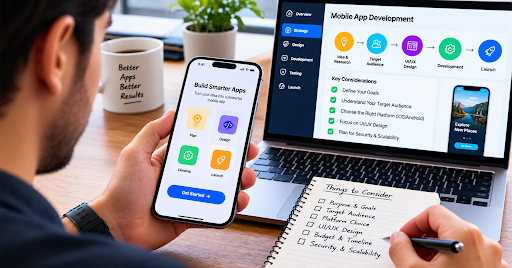
Most mobile apps fail not because the idea was bad or the development team was incompetent, but because someone skipped the hard thinking before writing a single line of code. The assumptions that seemed reasonable at the planning stage turn out to be wrong. The audience the app was built for doesn’t actually behave the way anyone expected. The platform choice gets made based on what the founder personally uses rather than where the target users actually are. By the time any of this surfaces, a significant budget has already been spent and reversing course is expensive. This pattern shows up so consistently that experienced teams at any reputable Mobile Application Development company will typically spend considerable time working through these questions before the development conversation even really begins because the decisions made before building starts often matter more than the decisions made during it.
There’s no perfect checklist for this, and every app is different. But there are a handful of questions that trip up first-time app builders reliably enough that they’re worth working through deliberately before anything else.
Who Is Actually Going to Use This, and What Do They Need?
This sounds obvious. It rarely gets answered as specifically as it needs to be.
“Everyone” is not a target audience. Neither is “small business owners” or “fitness enthusiasts” those are still too broad to be useful. The more specific the picture of the actual user, the better every downstream decision becomes. What device are they using? What’s their technical comfort level? What problem are they solving with this app, and what’s the context in which they’ll be solving it on a commute, at a desk, in a hurry, with both hands free?
The clearer this picture is before development begins, the less the team will have to guess later about what features matter, what the interface should feel like, and what performance constraints actually matter for this specific use case.
What Problem Does the App Solve, and Does It Actually Need to Be an App?
Not everything that can be an app should be one. An app requires someone to discover it, download it, give it permissions, learn it, and keep it installed. That’s a real ask, and users only say yes to it if the value proposition is genuinely strong enough to justify it.
Some things that get built as apps would be better served as a well-designed mobile website. Some ideas that come to founders as apps are really business process problems that need a different solution. This isn’t cynicism it’s just worth asking honestly whether the specific problem being solved actually benefits from the native app experience, or whether the app framing is just an assumption that never got examined.
Platform First: iOS, Android, or Both?
This decision has real budget and timeline implications and gets made too casually too often. A few things that actually matter here: where do the target users predominantly live? (Android dominates in many markets globally; iOS skews heavily in others.) Is there a revenue model that depends on in-app purchases, where platform economics matter? Is this a consumer app or an enterprise tool, and does the target organization run standardized devices?
Building for both platforms simultaneously is more expensive and takes longer. Building for one first and expanding later is faster and cheaper but delays reaching part of the audience. Neither answer is universally right it depends on where the actual users are and what the business model requires.
What Does the Minimum Viable Version Actually Include?
There’s a consistent tendency to overcomplicate the first version of an app. Features get added because they seem like good ideas, because a competitor has them, or because someone in a planning meeting got excited about a possibility. Most of these additions delay the launch of the core product without meaningfully improving user adoption.
The discipline of identifying the smallest version of the app that genuinely delivers value for the target user is genuinely hard. It requires saying no to things that seem useful, which feels counterintuitive when the whole point of the exercise is to build something. But a well-executed simple product ships faster, costs less to build, and generates real user feedback that informs what gets built next far better than a delayed, feature-heavy product ever does.
How Will People Actually Find This App?
App stores have a discovery problem. The vast majority of apps get downloaded primarily because someone was told about them, saw them advertised, or found them through a search not because they were browsing the app store and happened to stumble across something useful.
This isn’t a development question, but it belongs in the pre-development conversation because it affects what gets built. If the growth strategy depends on organic app store search, ASO (app store optimization) considerations should influence the product name, description, and feature set from day one. If the strategy is paid acquisition, the onboarding flow needs to convert efficiently because every user costs real money to acquire. If the strategy is word-of-mouth or referral, the app needs social mechanics baked in from the start.
What Will It Cost and What Gets Missed in That Number?
Getting a realistic budget figure before starting is important, but the more useful exercise is understanding what drives that number up or down. Factors That Affect Mobile App Development Cost include the platform or platforms being built for, the complexity of the backend infrastructure, whether the app integrates with third-party services or APIs, the level of custom design work involved, the compliance requirements for the specific industry, and whether ongoing post-launch maintenance is factored in or treated as a separate line item. Many first-time builders budget accurately for the build and then get surprised by the ongoing costs of keeping the app updated, maintaining compatibility with new OS versions, and continuing to develop features based on user feedback. The launch is the start of the investment, not the end of it.
What Are the Security and Privacy Requirements?
This depends heavily on what the app handles. A simple content app has very different obligations than an app that processes payments, stores health data, handles children’s information, or operates in a regulated industry. These requirements aren’t optional, and they’re not cheap to add after the fact which is why they belong in the planning conversation, not the compliance review six months after launch.
GDPR, CCPA, HIPAA, PCI-DSS whichever frameworks apply to the specific app and its target markets need to be understood before architecture decisions are made, because some compliance requirements directly influence how data gets stored, transmitted, and accessed at a level that’s very expensive to redo later.
How Will Success Be Measured?
This question gets skipped more than it should. Without clear metrics defined before launch, there’s no real way to know whether the app is working and no principled basis for deciding what to build next. Downloads are not a success metric. Neither is “engagement” as a vague concept.
Specific, measurable outcomes retention rate at seven days, conversion from free to paid, completion rate for a specific core workflow, support ticket volume per thousand users create a feedback loop that actually drives meaningful product decisions. The apps that improve consistently over time tend to be the ones where someone defined what improvement would look like before the first user ever downloaded anything.
Final Thoughts
Mobile app development is a significant investment, and the decisions made before a project starts often determine whether that investment pays off. The teams that spend real time on these questions honestly, specifically, with input from people who represent the actual target user rather than the founding team’s own preferences consistently produce better products than those that rush to the build phase with critical assumptions still unexamined.
The goal isn’t to eliminate uncertainty before starting. That’s not possible. The goal is to know which uncertainties remain, plan for them, and avoid building a product that fails for reasons that could have been predicted before anyone spent a dollar on development.