
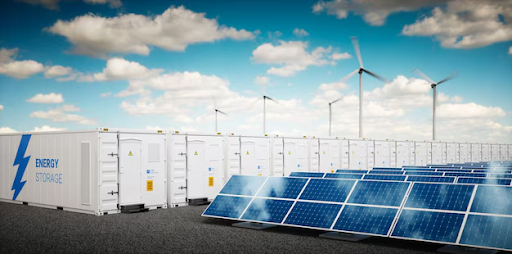
Solar panels generate electricity when the sun shines — but without a way to store that energy, any power not immediately used is lost or fed back to the grid. That is why choosing the right batteries for solar power storage is one of the most important decisions in any solar energy system installation. The right battery transforms a grid-dependent solar installation into a genuinely autonomous, resilient energy system capable of powering a home or business through the night, through cloudy periods, and through grid outages.
Why Battery Storage Is Essential for Solar Systems
A solar PV system without battery storage is fundamentally dependent on the grid or the moment-to-moment alignment of solar generation with consumption. Batteries for solar panels change this dynamic entirely — storing surplus daytime generation for use at night, during peak tariff periods, or when grid power is unavailable. For residential systems, this means significantly greater energy independence, reduced electricity bills, and backup power resilience. For off-grid and remote installations, solar energy storage batteries are not optional — they are the system.
Types of Solar Energy Storage Batteries
Lithium Iron Phosphate (LiFePO4) Batteries
Lithium Iron Phosphate batteries have become the dominant technology in solar PV energy storage batteries for good reason. They offer a combination of characteristics that are uniquely well-suited to stationary energy storage: very long cycle life (typically 3,000 to 6,000+ cycles at 80% depth of discharge), excellent thermal stability and safety compared to other lithium chemistries, high charge and discharge efficiency (95%+), a flat discharge voltage curve that maintains consistent power output, and no memory effect. LiFePO4 batteries are more expensive upfront than lead-acid alternatives but deliver a significantly lower cost per kilowatt-hour over their operational lifetime.
Lead-Acid Batteries (AGM and Gel)
Lead-acid technology — including Absorbent Glass Mat (AGM) and Gel variants — remains in use for solar energy storage, primarily in budget-constrained applications and in established off-grid installations where the technology is familiar to the installer. The advantages are lower upfront cost and wide availability of compatible components. The disadvantages are shorter cycle life (typically 300 to 700 cycles at 50% depth of discharge), lower usable capacity due to depth-of-discharge limitations, greater maintenance requirements, and sensitivity to temperature. For long-term solar energy systems, lithium-based storage now offers a compelling cost-per-cycle advantage over lead-acid.
Lithium NMC Batteries
Lithium Nickel Manganese Cobalt (NMC) batteries offer higher energy density than LiFePO4, making them suitable for applications where space and weight are significant constraints. They are commonly used in residential all-in-one storage systems where a compact footprint is important. NMC batteries carry slightly higher thermal management requirements than LiFePO4, making proper installation and BMS (Battery Management System) integration particularly important.
Key Specifications to Understand
Usable Capacity (kWh)
Usable capacity — the amount of stored energy available for actual use — is the primary sizing metric. It is calculated as the battery’s total capacity multiplied by its depth-of-discharge rating. A 10 kWh battery with an 80% DoD rating provides 8 kWh of usable storage. Size your battery bank based on your average daily consumption and the number of autonomy days (consecutive off-solar days) you need to cover.
Cycle Life
Cycle life — the number of full charge-discharge cycles a battery can complete before its capacity falls below a specified threshold (typically 80%) — is one of the most important long-term value indicators. Higher cycle life translates directly to lower cost per usable kWh over the battery’s operational life.
C-Rate
C-rate describes the rate at which a battery can be charged or discharged relative to its capacity. A 1C rate means the battery can be fully charged or discharged in one hour. For solar storage applications, a C-rate between 0.5C and 1C is typical for residential systems. Higher C-rates are important for applications with high instantaneous power demand.
Solar PV Energy Storage Batteries: Installation Considerations
All solar storage battery installations should include a properly specified Battery Management System (BMS) that monitors cell voltages, temperatures, and state of charge to protect the battery from overcharge, deep discharge, and thermal events. Batteries should be installed in a temperature-controlled environment where possible, as both very high and very low temperatures affect performance and longevity. All installation work should be performed by a qualified electrician familiar with DC battery systems and relevant local codes.
Conclusion
Choosing the right batteries for solar power storage is the decision that determines how effectively your solar investment performs over the long term. Prioritize cycle life, usable capacity, safety chemistry, and system compatibility when evaluating options. Lithium Iron Phosphate technology currently represents the best combination of performance, safety, and long-term value for most residential and commercial solar energy storage applications — making it the benchmark against which all other options should be measured.