
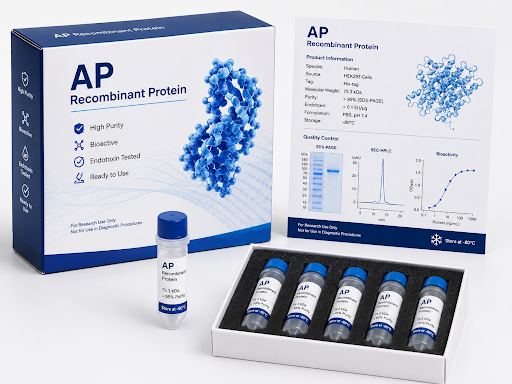
Proteins are essential biological molecules that regulate nearly every process within living organisms. They serve as enzymes, signaling molecules, structural components, transporters, and regulators of cellular activity. To better understand protein function and biological pathways, researchers frequently use recombinant protein technology to produce highly purified proteins for laboratory investigations.
Among the many proteins utilized in scientific studies, AP recombinant proteins are valuable research tools for examining molecular interactions, cellular signaling, enzymatic activity, and disease-related biological mechanisms. Recombinant proteins enable scientists to investigate protein behavior under controlled conditions, helping advance research in biotechnology, drug discovery, immunology, and molecular biology.
What Are Recombinant Proteins?
Recombinant proteins are proteins produced through genetic engineering techniques. Scientists introduce a gene encoding a target protein into a host expression system, such as bacteria, yeast, insect cells, or mammalian cells. The host cells then produce the desired protein, which can be purified for research use.
Recombinant protein technology offers several advantages:
- High protein purity
- Consistent production
- Scalable manufacturing
- Controlled expression conditions
- Enhanced experimental reproducibility
- Availability of rare proteins
- Support for functional studies
Because of these benefits, recombinant proteins have become indispensable tools across many scientific disciplines.
Why Researchers Use Recombinant Proteins
Studying proteins directly from natural tissues can be challenging due to limited availability, contamination risks, and biological variability. Recombinant proteins help overcome these limitations by providing standardized materials for experimentation.
Researchers commonly use recombinant proteins for:
- Functional characterization
- Cell signaling studies
- Drug screening
- Antibody development
- Assay validation
- Biomarker research
- Structural biology investigations
These applications help scientists better understand molecular pathways and disease-associated mechanisms.
Applications in Molecular Biology
Proteins participate in complex cellular networks that regulate growth, differentiation, metabolism, and survival. Recombinant proteins allow researchers to isolate specific molecular components and study their functions independently.
Scientists often use recombinant proteins to investigate:
- Protein-protein interactions
- Receptor binding mechanisms
- Signal transduction pathways
- Gene regulation networks
- Enzymatic activity
- Cellular communication
These studies contribute to a deeper understanding of cellular biology and physiological regulation.
Importance in Drug Discovery
The pharmaceutical industry relies heavily on recombinant protein technologies during drug development. Researchers use purified proteins to identify therapeutic targets and evaluate candidate compounds.
For laboratories conducting these investigations, high-quality ap recombinant protein products can provide reliable experimental materials for studying molecular interactions and assessing biological activity.
Common drug discovery applications include:
- Target validation
- Compound screening
- Mechanism-of-action studies
- Binding affinity analysis
- Therapeutic development research
The availability of recombinant proteins has significantly accelerated pharmaceutical innovation and biomedical research.
Role in Immunology Research
Understanding immune system function requires detailed analysis of proteins involved in immune signaling and pathogen recognition. Recombinant proteins are frequently used to evaluate immune responses and develop research tools.
Applications include:
- Antibody generation
- Antigen characterization
- Cytokine studies
- Vaccine research
- Immune signaling investigations
- Diagnostic assay development
These studies support advances in infectious disease research, immunotherapy, and biomarker discovery.
Structural Biology and Protein Characterization
Protein structure plays a critical role in determining biological function. Recombinant proteins provide researchers with sufficient quantities of purified material for structural and biochemical analysis.
Scientists use recombinant proteins for:
- Crystallography studies
- Protein folding analysis
- Stability testing
- Functional domain mapping
- Molecular interaction research
- Enzyme activity assessments
These investigations help reveal how proteins operate at the molecular level.
Factors to Consider When Selecting Recombinant Proteins
The quality of a recombinant protein can significantly influence experimental outcomes. Researchers should carefully review product specifications before selecting a protein for study.
Important considerations include:
- Protein purity
- Biological activity
- Expression system
- Structural integrity
- Quality control testing
- Storage requirements
- Validation data
Choosing a well-characterized protein helps improve reproducibility and confidence in research findings.
Best Practices for Protein Handling
Maintaining protein stability is essential for preserving biological activity.
Researchers should:
- Follow recommended storage conditions
- Minimize freeze-thaw cycles
- Use appropriate buffer systems
- Handle proteins gently during preparation
- Verify concentration before use
- Monitor activity when required
- Maintain contamination-free procedures
These practices help ensure optimal experimental performance.
Future Trends in Recombinant Protein Research
Advances in protein engineering, synthetic biology, and expression technologies continue to expand the capabilities of recombinant protein production. Researchers can now generate proteins with enhanced stability, modified functionality, and improved application-specific properties.
Growing interest in biologics, personalized medicine, regenerative therapies, and targeted drug development is expected to increase demand for recombinant proteins across both academic and commercial research sectors.
Emerging technologies are also enabling more precise protein design, opening new opportunities for therapeutic innovation and scientific discovery.
Conclusion
Recombinant proteins are fundamental tools in modern biomedical research, supporting studies in molecular biology, immunology, drug discovery, structural biology, and biotechnology. Their ability to provide consistent, high-quality protein material enables researchers to investigate complex biological processes with greater accuracy and efficiency. As scientific technologies continue to advance, recombinant proteins will remain essential resources for expanding knowledge, developing new therapies, and driving innovation across the life sciences.