
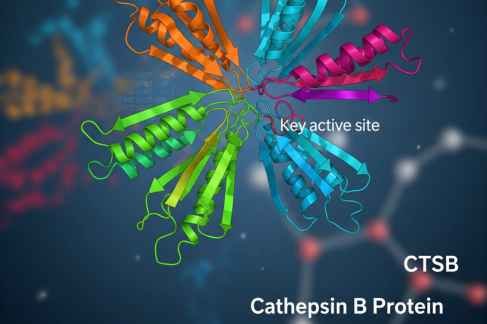
Not every protein studied in a molecular biology lab makes headlines, but a handful of enzymes keep reappearing across very different fields of research simply because of how central their function is to cell biology. Cathepsin B is one of those proteins, showing up in work on neurodegeneration, cancer biology, and cardiac remodeling alike.
What This Protease Does Inside the Cell
This enzyme is a lysosomal cysteine protease that plays a central role in intracellular protein degradation and turnover. It is synthesized as a longer precursor protein and processed into its mature, active form inside the lysosome, where it participates in breaking down proteins that are no longer needed by the cell. Structurally, the active enzyme is composed of a dimer of disulfide-linked heavy and light chains, both derived from the same original precursor.
Beyond routine protein turnover, this protease has also been implicated in the proteolytic processing of amyloid precursor protein, a process connected to research on Alzheimer’s disease, and it has been studied for a role in tumor invasion and metastasis, since excessive extracellular activity can contribute to the breakdown of surrounding tissue barriers.
Why Recombinant Protein Is Useful for This Target
Studying an enzyme’s function, screening potential inhibitors, or validating an antibody all typically require a reliable source of purified protein. Recombinant production allows researchers to generate consistent, well-characterized material without depending on tissue extraction, which can vary in purity and yield from batch to batch.
Native protein isolated directly from tissue also carries the risk of co-purifying contaminants or trace amounts of related family members, which can confound activity assays or skew antibody validation results. A well-documented recombinant preparation, with a defined sequence and expression system, removes much of that ambiguity from the experimental design.
Working With Cathepsin B Protein (CTSB) in the Lab
A recombinant Cathepsin B Protein (CTSB) product is typically expressed using one of several host systems, including E. coli, yeast, baculovirus-insect cell systems, or mammalian cell lines, each offering different advantages depending on whether post-translational modifications are important for the downstream application. Purity is generally confirmed by SDS-PAGE, and the protein is supplied either lyophilized or in liquid form, often carrying an affinity tag to simplify purification and detection.
Because this protease belongs to the peptidase C1 family, its activity and specificity are well characterized, which makes recombinant preparations useful for enzymatic activity assays, structural studies, and as a positive control when validating new antibodies raised against the same target.
Research Applications Worth Knowing About
This protein turns up across a broad range of study areas, including:
- Neuroscience research examining amyloid precursor protein processing and neurodegenerative disease pathways
- Cancer biology studies of tumor invasion, extracellular matrix degradation, and metastasis
- Cardiac research into hypertrophic signaling pathways, including work connecting this protease to TNF-alpha and JNK signaling in cardiac remodeling
- Immunology studies involving antigen processing and presentation pathways
- Extracellular matrix and collagen degradation research more broadly
Given how many pathway databases list this enzyme under lysosomal, immune system, and extracellular matrix organization categories, it is a useful reference point for researchers mapping out protease involvement in a particular disease model.
Practical Considerations Before Ordering
When selecting a recombinant protein for a new experiment, it helps to confirm the expression host, since tag placement, glycosylation, and folding can all differ between bacterial and mammalian systems. Reviewing the exact sequence positions included in the construct, along with molecular weight and purity data from the certificate of analysis, ensures the material matches what the experimental design actually requires.
Storage matters too. Most recombinant proteins need to be kept at -20°C or -80°C for long-term storage, with working aliquots held at 4°C for no more than about a week, since repeated freeze-thaw cycles can reduce activity over time.
Reputable suppliers typically publish full technical datasheets, including sequence information and species-specific data, alongside each recombinant protein listing, which is worth reviewing closely before finalizing a protocol. Matching the expression system, tag, and purity level to the specific downstream assay is generally the deciding factor in getting clean, reproducible results from any lysosomal protease study, whether the end goal is an activity assay, an inhibitor screen, or antibody validation work.