
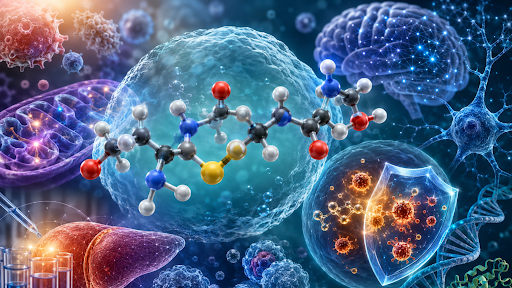
Oxidative stress is now recognized as a central contributor to aging, inflammation, neurodegeneration, cancer progression, and metabolic dysfunction. As research into cellular defense systems expands, few biomolecules have received as much scientific attention as glutathione. This naturally occurring tripeptide is considered one of the most important intracellular antioxidants due to its broad involvement in detoxification, redox signaling, immune regulation, and mitochondrial maintenance.
For researchers investigating oxidative damage, cellular metabolism, or biomarker discovery, accurate quantification of Glutathione has become increasingly important in both translational and basic biomedical studies.
What Is Glutathione?
Glutathione (GSH) is a low-molecular-weight tripeptide composed of glutamate, cysteine, and glycine. It exists primarily in a reduced form (GSH) and an oxidized form (GSSG), together forming one of the body’s most important redox buffering systems. Glutathione is found in nearly all living cells and is especially abundant in tissues with high metabolic activity, including the liver, brain, lungs, and immune cells.
Its thiol-containing cysteine residue gives glutathione exceptional reducing capacity, enabling it to neutralize reactive oxygen species (ROS), detoxify xenobiotics, and maintain intracellular redox equilibrium. Because intracellular glutathione concentrations can reach millimolar levels, it serves as a primary defense mechanism against oxidative injury.
Glutathione and Oxidative Stress Regulation
Reactive oxygen species are continuously generated during mitochondrial respiration and normal metabolic processes. Under physiological conditions, antioxidant systems efficiently regulate ROS concentrations. However, excessive ROS accumulation can damage DNA, proteins, and membrane lipids, leading to cellular dysfunction.
Glutathione plays a major role in limiting oxidative damage through several mechanisms:
- Direct scavenging of free radicals and peroxides
- Serving as a substrate for glutathione peroxidase enzymes
- Regenerating oxidized antioxidants such as vitamins C and E
- Maintaining sulfhydryl groups in proteins
- Supporting mitochondrial integrity and energy metabolism
The ratio between reduced glutathione (GSH) and oxidized glutathione (GSSG) is widely used as an indicator of cellular oxidative stress. A decline in the GSH/GSSG ratio frequently reflects impaired antioxidant capacity and altered metabolic homeostasis.
Importance in Cellular Signaling and Metabolism
Although glutathione was historically viewed primarily as an antioxidant, recent research has revealed its broader regulatory functions in intracellular signaling pathways. Glutathione participates in redox-sensitive signal transduction mechanisms that influence gene expression, cell proliferation, apoptosis, and inflammatory responses.
Several transcription factors, including Nrf2 and NF-κB, are affected by glutathione-mediated redox balance. These signaling pathways regulate antioxidant enzyme expression, immune activity, and cellular adaptation to stress conditions.
Glutathione also contributes to:
- Protein folding within the endoplasmic reticulum
- Iron-sulfur cluster assembly
- Nitric oxide metabolism
- Detoxification of electrophilic compounds
- Regulation of ferroptosis and programmed cell death
Because these pathways are interconnected with mitochondrial function and metabolic regulation, glutathione depletion often contributes to systemic pathological changes.
Glutathione in Disease Research
Abnormal glutathione metabolism has been implicated in numerous diseases characterized by chronic oxidative stress and inflammation. Reduced intracellular glutathione levels are frequently observed in neurodegenerative disorders, cardiovascular diseases, diabetes, liver dysfunction, autoimmune conditions, and malignancies.
Neurodegenerative Disorders
Oxidative damage is strongly associated with diseases such as Parkinson’s disease, Alzheimer’s disease, and amyotrophic lateral sclerosis (ALS). Neurons are particularly vulnerable to oxidative stress because of their high oxygen demand and limited regenerative capacity. Several studies suggest that glutathione depletion may precede neuronal degeneration in certain neurodegenerative conditions.
Cancer Biology
The relationship between glutathione and cancer is highly complex. On one hand, glutathione protects cells from DNA damage and carcinogenic insults. On the other hand, elevated glutathione levels in tumor cells may contribute to chemotherapy resistance and enhanced survival under oxidative stress conditions.
Consequently, glutathione metabolism has emerged as a potential therapeutic target in oncology research.
Liver and Metabolic Disease
The liver relies heavily on glutathione-dependent detoxification systems to process xenobiotics, drugs, and metabolic byproducts. Impaired glutathione homeostasis is linked to fatty liver disease, insulin resistance, and chronic inflammatory disorders.
Analytical Measurement of Glutathione
Because glutathione status reflects cellular oxidative balance, its quantitative measurement has become a valuable research tool across molecular biology, pharmacology, toxicology, and clinical studies.
Several analytical methods are used for glutathione detection, including:
- High-performance liquid chromatography (HPLC)
- Mass spectrometry
- Fluorescence-based assays
- Spectrophotometric methods
- ELISA-based detection systems
Among these approaches, ELISA assays offer advantages in sensitivity, scalability, reproducibility, and compatibility with high-throughput laboratory workflows. Researchers frequently use ELISA methodologies for evaluating glutathione concentrations in serum, plasma, tissue lysates, and cultured cells.
Reliable glutathione quantification is especially important when investigating:
- Oxidative stress biomarkers
- Drug-induced toxicity
- Antioxidant therapeutic responses
- Mitochondrial dysfunction
- Aging-related cellular damage
- Inflammatory signaling pathways
Emerging Directions in Glutathione Research
Modern glutathione research is increasingly moving beyond traditional antioxidant biology. Investigators are now exploring glutathione’s role in epigenetic regulation, ferroptosis, immunometabolism, and redox-dependent signaling networks.
Advanced studies are also examining glutathione compartmentalization within mitochondria, nuclei, and endoplasmic reticulum structures. These investigations may provide new insight into how localized redox changes influence disease progression and therapeutic responsiveness.
Additionally, growing interest in precision medicine has increased demand for robust oxidative stress biomarkers capable of supporting patient stratification and treatment monitoring. Because glutathione status reflects both metabolic and inflammatory conditions, it remains a highly valuable target for biomarker development.
Conclusion
Glutathione occupies a central position in cellular physiology due to its involvement in antioxidant defense, metabolic regulation, detoxification, and intracellular signaling. Its ability to maintain redox homeostasis makes it indispensable for protecting cells against oxidative injury and maintaining normal biological function.
As oxidative stress continues to emerge as a unifying mechanism across numerous diseases, glutathione research remains highly relevant to modern biomedical science. Accurate measurement of glutathione concentrations is therefore essential for researchers studying inflammation, mitochondrial dysfunction, neurodegeneration, cancer biology, and therapeutic intervention strategies.
Continued investigation into glutathione metabolism and redox signaling will likely provide deeper insight into disease mechanisms and may contribute to the development of novel diagnostic and therapeutic approaches in translational medicine.